Wednesday, December 1, 2010

Car-culture in developed world causes pain in less-developed

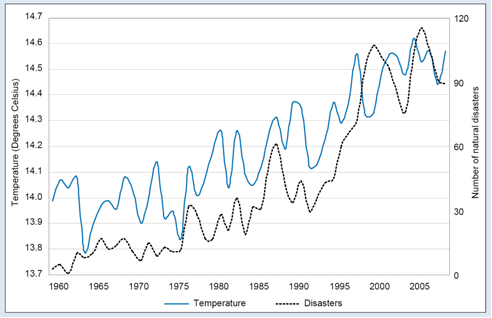
World temperature and natural disasters in LDCs, 1960-2009

UNCTAD.ORG >> Press releases >> Study urges scaled-up, improved financing for climate change adaptation in least developed countries: "The report finds that there has been an increase in the frequency and intensity of extreme weather events in LDCs, with five times as many such incidents occurring from 2000 to 2010 as during the 1970s. During the period 2000-2010, LDCs recorded economic losses totalling $14.1 billion. Within the LDC Group, Bangladesh and Myanmar suffered the greatest economic losses ($5.8 billion and $4.5 billion respectively). Overall, LDCs and small island developing States (SIDS) are among the most susceptible in the world to natural disasters, as a result of which they suffer significant shocks to their economies."

Thursday, November 25, 2010

Looking Ahead: Climate Change Likely to Harm Indian Economy by 2030 | Anjali Jaiswal's Blog | Switchboard, from NRDC

Looking Ahead: Climate Change Likely to Harm Indian Economy by 2030 | Anjali Jaiswal's Blog | Switchboard, from NRDC: "While in the U.S. some political leaders unbelievably debate whether climate change is happening, India is looking ahead to how climate change will impact its rapidly growing economy.  India recently released the first-ever scientific study that assessed the impacts of climate change by 2030 on agriculture, health, water and forests and underscores India’s vulnerability to climate change – including extreme drought and monsoons, rapid sea level rise, and fluctuating rice and corn yields. "

Sunday, November 14, 2010

-- Press Releases November 2010 - India Steers Full Speed towards Low Carbon Transport - United Nations Environment Programme (UNEP) --


-- Press Releases November 2010 - India Steers Full Speed towards Low Carbon Transport - United Nations Environment Programme (UNEP) --: "Launched in New Delhi, Thursday, a new 2.49 million Euros three-year project - funded by the German International Climate Initiative and supported by the United Nations Environment Programme (UNEP) - will support the Indian Government's efforts to align transport growth with the country's climate change agenda and national development plan."

Saturday, October 23, 2010

: Bangladesh, India most at risk from climate change

: Bangladesh, India most at risk from climate change: "Bangladesh and India are the countries most vulnerable to climate change, according to an index on Wednesday that rates the Nordic region least at risk."

Saturday, October 9, 2010

TH!NK ABOUT IT - CLIMATE CHANGE - blogging competition

TH!NK ABOUT IT - CLIMATE CHANGE - blogging competition: "The human population has doubled twice in last hundred years. One way of saying that is: in only last 100 years there were 4 times as many humans as compared to the total number of human beings till the beginning of 20th century. If that’s scary, Energy consumption by us is doubling 4 times faster than population growth. Number of automobiles is doubling ten times faster than population growth. I find this aspect of growth somewhat ‘demonic’. Our growth, in many ways, is runaway."

Monday, October 4, 2010

Is Public Transport a drain on cities?

Public Transport activists are often told by the local city administration/government that Public Transport is a big problem as it is a drain on the coffers of the city. "Public Transport loses money and the city can't afford to subsidize it beyond a certain extent.

A big lie, because profit and loss from public transport (transit) can't be worked out from fare (ticket ) collection alone. One must quantify the invisible benefits to the city from a well functioning public transport system. Add up the cost of air, soil and noise pollution on the city and health of its citizens, add up the cost of medication to treat respiratory diseases, hypertension, heart disease and even cancers directly or indirectly connected to automobile effluents. Add up the cost of never-ending road construction, flyovers, underpasses, accidents and stress of driving in congestion primarily caused by personal automobiles. Add to this the cost of building parking lots and other infrastructure for the automobile and you'll begin to see the real cost of automobile dominated city planning.

You will then see how much Public Transport users subsidize the city because public transport vehicles cause far less pollution, contribute far less to road congestion and accidents when compared to personal auto vehicles. If more people use public transit the city will be a much better place to live in.

But people won't get out of their personal auto vehicles unless public transit is economical and unless the city puts in place severe constraints (like expensive parking levies, congestion charging and creation of car-free areas). Free Public Transport can thus become an important step to move in this direction.

Sujit Patwardhan
Pune, India
www.parisar.org
Parisar

Parisar: "Parisar organised a national level round-table “The City and the Metro”, held at Yashada, Pune, on 20th and 21st July 2010. Many cities in India are going in for Metro Rail systems in an attempt to address their transportation problems. Such systems are already in operation in Kolkata and Delhi with other cities in the process of building a metro system. In total, India is expected to invest Rs. 2 lakh crores (40 billion dollars) in Metro rail systems over the next 10 years. Presently a public debate is taking place in the city across a variety of issues about the proposed Metro Rail System being considered for Pune."